Remember that old writing assignment from school? The one entitled "What I Did for My Summer Vacation?"
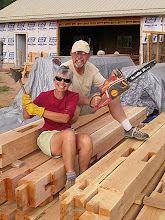
Well, when our longtime friend, Nikki, and her friend, Tracey, get back to Chicago, they'll be able to answer that question with two words...sanding and sealing. Nikki drove all the way to Torrey in July and spent many long hours sanding braces and trusses plus working on a long list of odds and ends. As if that wasn't enough fun, she came back last week with Tracey, and together they spent another five days sanding and applying Skidmore's Liquid Beeswax to twenty-eight porch posts.
Sanding is a time-consuming, arm-numbing job that taxes muscles and fills lungs with saw dust. We've christened our belt sander, an experienced Rockwell, The Locomotive because of its deafening roar and its ability to knock you off your feet if you are unprepared for takeoff when you push the trigger.
How did we get so lucky as to have friends who spend their summer vacation like this?
Wednesday, September 22, 2010
Sunday, September 5, 2010
Some Assembly Required
Over a year ago, beginning on August 15, 2009, Scott and I had a lesson on timber framing with Adam Riley from Teton Timber Frame Company. He and Jake, one of his employees, drove to Torrey from Driggs, Idaho to teach us as much as they could cram into our brains in three long days about the business of cutting our own timbers. At the end of the crash course, we had cut the posts, girts and truss for one bent of our eight-bent house. Scott and I were exhausted, and I shed a good number of tears because it had been so much work and we had so far to go.
In September we spent another three weeks building two more trusses. It was a challenge trying to decipher what all of our notes from Adam and Jake meant, not to mention dealing with timbers that had had another month to twist and turn in the heat of the warm autumn days. Still, as that building season ended, we felt we would really be able to complete work this summer.
Always the optimist, I thought we would be finished and ready for a raising by early July. Scott, the realist in the team, thought we’d be lucky to be ready in early August. A year and ten days after our shaky beginning, all of that work came together as Adam, his employee Mike, my mom, Wayne, Doug, Shanna, Scott and I raised the frame of our house.
Scott set up his camera to take a picture every few minutes to record the whole affair. It’s plain to see that some assembly was required.
In September we spent another three weeks building two more trusses. It was a challenge trying to decipher what all of our notes from Adam and Jake meant, not to mention dealing with timbers that had had another month to twist and turn in the heat of the warm autumn days. Still, as that building season ended, we felt we would really be able to complete work this summer.
Always the optimist, I thought we would be finished and ready for a raising by early July. Scott, the realist in the team, thought we’d be lucky to be ready in early August. A year and ten days after our shaky beginning, all of that work came together as Adam, his employee Mike, my mom, Wayne, Doug, Shanna, Scott and I raised the frame of our house.
Scott set up his camera to take a picture every few minutes to record the whole affair. It’s plain to see that some assembly was required.
Saturday, August 21, 2010
Waiting to Exhale
Last week we finished working with all of the timbers for our house - 42 purlins; 8 trusses each composed of 6 members: two top cords, one bottom cord, two struts and one king post; 16 posts; 44 braces; 16 girts and 20 splines. Every piece is sanded, sealed with Skidmore's Liquid Beeswax, fitted and waiting under a tarp for the moment it will stand together with its brothers and sisters as the frame of our house. All around the building site you see blue and silver tarps covering pieces of our house. Scott reminds me that some people put cars on blocks in front of their houses. We have put pieces of a house on blocks in front of our car.
I've returned to Logan to resume my part time work at Utah State University, but Doug, Shanna and Scott have continued preparing for the raising of our timber frame. The tractor (named Orangejello) proves to be the useful tool we had hoped it would be, especially now, as it is instrumental in making piles of dirt disappear into the holes left behind following each excavation.
In less than a week, despite day after day of rain, they have even erected the core of our Tempcast masonry heater. Here's a tour of their work.
The pieces are laid out.
Doug applies mortar in preparation for the next part.
More mortar...
More mortar...
Scott custom cuts a hole for the flue.
It begins to look like a masonry heater instead of just a pile of cement blocks.
Another course...
The last two courses are the heaviest pieces weighing in at 126 pounds. This requires a scaffold assist.
Scott stands beside the almost completed heater.
Scott and Doug contemplate the last piece.
The last piece...
The heater is not really finished. This is just the core. Once the walls of the house are up, and we are happily whiling away our time with finish work, we'll add an attractive facade which we haven't yet decided upon.
The fitting of all of the timbers has taken place in two dimensions on the ground, so we don't REALLY know that our grand plan will work. We are tired. We are anxious. We are excited. We are waiting until our mentors from Teton Timberframe arrive next Tuesday. It will be a big day (or several). We are ready to move on to something less demanding. Maybe that will be the strawbale walls. We are waiting to exhale.
I've returned to Logan to resume my part time work at Utah State University, but Doug, Shanna and Scott have continued preparing for the raising of our timber frame. The tractor (named Orangejello) proves to be the useful tool we had hoped it would be, especially now, as it is instrumental in making piles of dirt disappear into the holes left behind following each excavation.
In less than a week, despite day after day of rain, they have even erected the core of our Tempcast masonry heater. Here's a tour of their work.
The pieces are laid out.
Doug applies mortar in preparation for the next part.
More mortar...
More mortar...
Scott custom cuts a hole for the flue.
It begins to look like a masonry heater instead of just a pile of cement blocks.
Another course...
The last two courses are the heaviest pieces weighing in at 126 pounds. This requires a scaffold assist.
Scott stands beside the almost completed heater.
Scott and Doug contemplate the last piece.
The last piece...
The heater is not really finished. This is just the core. Once the walls of the house are up, and we are happily whiling away our time with finish work, we'll add an attractive facade which we haven't yet decided upon.
The fitting of all of the timbers has taken place in two dimensions on the ground, so we don't REALLY know that our grand plan will work. We are tired. We are anxious. We are excited. We are waiting until our mentors from Teton Timberframe arrive next Tuesday. It will be a big day (or several). We are ready to move on to something less demanding. Maybe that will be the strawbale walls. We are waiting to exhale.
Tuesday, August 3, 2010
Finding Straw
Last winter when Scott was searching for a straw source, he was having no luck finding anything in Wayne County. He could find straw specifically baled for construction purposes in Manitoba, Canada (definitely not local) or western Colorado (better, but still pretty far away). We knew farmers with straw in Cache Valley, too, but that was no closer than the Colorado location.
Early this spring Scott was discussing our dilemma with Courtney Cropper. Courtney manages the water on the ten acres that abut our Torrey property. He said that his dad was planting barley in Hinkley, Utah and would have straw after the harvest. Now Hinkley isn’t exactly near Torrey either, but when you’re getting desperate, 130 miles can be construed as sort of local.
As it turned out, Courtney’s dad hadn’t planted barley, but his friend, Donald Brown, knew where we could get straw. A fellow living in Las Vegas had a field near Donald’s place that was full of soon-to-be-straw and we could purchase it for $90 a ton. Donald’s neighbor, Gale Bennet, would bale it for us, and their friends at G. C. Porter Trucking would haul it two and half hours to our place.
A week ago Monday we drove to Hinkley to take a look at the bales. It was important for us to see bright, dry straw in bales the correct size - 18” X 14” in lengths that kept them light enough that we could heft them around, somewhere in the neighborhood of 50-60 pounds. We met Gale at the barley field, watched the baler spit out a few bales and were happy with the results. These bales were dry, tight, and not too heavy.
Then it appeared Murphy and his law might prevail. Gale's baler broke so the straw wasn't baled until Wednesday. It was stacked in the open, then loaded on the truck Friday and left uncovered overnight. There had been thunderstorms all over the state during the week, including several downpours in and around Torrey, and we nervously watched the radar on the internet to see if Hinkley had been hit by a storm. Baled straw can shake off a bit of dampening by a shower, but a deluge can ruin it all. The building gods were with us and we received a call early Saturday informing us that 500 dry bales were headed our way.
In advance we hired three young men to help unload the semi load of straw and put it under the roof of our garage. Anything that didn’t fit in the garage would be in a stacked outside and covered with a tarp.
Saturday morning we were up bright and early in anticipation of the arrival of our straw, and at 9:00 the semi turned down our lane.
In my mind, 500 bales just sounded like a number - 500 people, 500 dollars, 500 miles. But when I saw that semi plus the “pup” behind it stacked with a full load, 500 bales seemed like a mountainous number, an immeasurable number, a number that would make me very tired.
Luke and Aaron Porter (G. C. Porter Trucking Company) maneuvered the semi through our gate to the garage door. Brenden, Troy and Jason flexed their young muscles and the unloading and stacking began. Soon everyone pitched in. Jason and Aaron heaved the bales off the semi, that is until Aaron slipped and tumbled twelve feet to the ground. He didn’t seem seriously injured, but we gave him an ice pack to put on a swelling wrist and directed him to watch and cheer everyone on. (We checked on him yesterday and found he currently has a brace on a "slight fracture".) I climbed up beside Jason and the two of us continued to trundle bales off our slowly diminishing pile on the trailer to the crew filling the garage. Scott,Troy, Luke and Brenden stacked and stacked and stacked. Courtney came with his tractor to move the unhitched “pup” into unloading position, and stayed to do more than his share of unloading as well.
Two and a half hours later, our once empty garage was filled to the rafters with straw. A tidy 50-bale stack covered with a tarp stood beside it.
Scott often says, “Proceed and the way will open.” Courtney connected us to Donald Brown. Donald went out of his way to help us with the logistics of getting 13 tons of straw from Hinkley to Torrey. Our timbers are scheduled to go up August 25 - 27. Then we begin raising the walls of straw. We’ll proceed...and the way will open.
Early this spring Scott was discussing our dilemma with Courtney Cropper. Courtney manages the water on the ten acres that abut our Torrey property. He said that his dad was planting barley in Hinkley, Utah and would have straw after the harvest. Now Hinkley isn’t exactly near Torrey either, but when you’re getting desperate, 130 miles can be construed as sort of local.
As it turned out, Courtney’s dad hadn’t planted barley, but his friend, Donald Brown, knew where we could get straw. A fellow living in Las Vegas had a field near Donald’s place that was full of soon-to-be-straw and we could purchase it for $90 a ton. Donald’s neighbor, Gale Bennet, would bale it for us, and their friends at G. C. Porter Trucking would haul it two and half hours to our place.
A week ago Monday we drove to Hinkley to take a look at the bales. It was important for us to see bright, dry straw in bales the correct size - 18” X 14” in lengths that kept them light enough that we could heft them around, somewhere in the neighborhood of 50-60 pounds. We met Gale at the barley field, watched the baler spit out a few bales and were happy with the results. These bales were dry, tight, and not too heavy.
Then it appeared Murphy and his law might prevail. Gale's baler broke so the straw wasn't baled until Wednesday. It was stacked in the open, then loaded on the truck Friday and left uncovered overnight. There had been thunderstorms all over the state during the week, including several downpours in and around Torrey, and we nervously watched the radar on the internet to see if Hinkley had been hit by a storm. Baled straw can shake off a bit of dampening by a shower, but a deluge can ruin it all. The building gods were with us and we received a call early Saturday informing us that 500 dry bales were headed our way.
In advance we hired three young men to help unload the semi load of straw and put it under the roof of our garage. Anything that didn’t fit in the garage would be in a stacked outside and covered with a tarp.
Saturday morning we were up bright and early in anticipation of the arrival of our straw, and at 9:00 the semi turned down our lane.In my mind, 500 bales just sounded like a number - 500 people, 500 dollars, 500 miles. But when I saw that semi plus the “pup” behind it stacked with a full load, 500 bales seemed like a mountainous number, an immeasurable number, a number that would make me very tired.
Luke and Aaron Porter (G. C. Porter Trucking Company) maneuvered the semi through our gate to the garage door. Brenden, Troy and Jason flexed their young muscles and the unloading and stacking began. Soon everyone pitched in. Jason and Aaron heaved the bales off the semi, that is until Aaron slipped and tumbled twelve feet to the ground. He didn’t seem seriously injured, but we gave him an ice pack to put on a swelling wrist and directed him to watch and cheer everyone on. (We checked on him yesterday and found he currently has a brace on a "slight fracture".) I climbed up beside Jason and the two of us continued to trundle bales off our slowly diminishing pile on the trailer to the crew filling the garage. Scott,Troy, Luke and Brenden stacked and stacked and stacked. Courtney came with his tractor to move the unhitched “pup” into unloading position, and stayed to do more than his share of unloading as well.
Two and a half hours later, our once empty garage was filled to the rafters with straw. A tidy 50-bale stack covered with a tarp stood beside it.Scott often says, “Proceed and the way will open.” Courtney connected us to Donald Brown. Donald went out of his way to help us with the logistics of getting 13 tons of straw from Hinkley to Torrey. Our timbers are scheduled to go up August 25 - 27. Then we begin raising the walls of straw. We’ll proceed...and the way will open.
Wednesday, July 28, 2010
Sunday, July 25, 2010
Not Building a Piano
Today we will finish the detail work on the the last of our eight trusses. Now we have all of the timber cut (and much of it fitted) except for the 48 purlins These are horizontal roof members spanning between trusses. The roof is attached to the purlins. Ever the optimist, I don't think cutting the purlins will take long. Scott says it will take forever because our wood has twisted a good deal since it was cut last fall. The reality is likely somewhere in between. We are hoping for a September frame raising. Fingers crossed...
Yesterday we took the tarps off of all the trusses in our yard. We were happy to see that, over the months, we have actually gotten better putting the pieces together. Even so, it is impossible for us to be as skilled as our tutors, Adam and Jake, who have been building timber frame structures for years. Scott says if anyone makes negative comments about our joinery, just tell them we weren’t building a piano.
It was recommended that we seal all of our wood with Skidmore’s Liquid Beeswax. It is very expensive, and, when we opened the lid, we could see why. The amber liquid exudes the efforts of thousands of bees who couldn’t have know their work would be enshrined in the timbers of our house. And I couldn’t have known the effect this unguent would have on our wood.

When we applied the first brush strokes to one of our trusses, Scott said, “What do you think?” I said, “Now it looks like a piano!”
Yesterday we took the tarps off of all the trusses in our yard. We were happy to see that, over the months, we have actually gotten better putting the pieces together. Even so, it is impossible for us to be as skilled as our tutors, Adam and Jake, who have been building timber frame structures for years. Scott says if anyone makes negative comments about our joinery, just tell them we weren’t building a piano.
It was recommended that we seal all of our wood with Skidmore’s Liquid Beeswax. It is very expensive, and, when we opened the lid, we could see why. The amber liquid exudes the efforts of thousands of bees who couldn’t have know their work would be enshrined in the timbers of our house. And I couldn’t have known the effect this unguent would have on our wood.

When we applied the first brush strokes to one of our trusses, Scott said, “What do you think?” I said, “Now it looks like a piano!”
The Last Hole
We plan to heat our house with two systems: a Tempcast masonry heater and radiant heat flooring powered by solar-thermal collectors. The basic idea behind the solar-thermal system is to collect the sun’s energy with water-filled evacuated tubes on the roof and store it in a large thermal mass - a lot of water - enough water to store heat from sunny days through cold cloudy days. When we figured our budget for collectors and tanks, and our likely heating needs, 500 gallons turned out to be the required amount to efficiently run the system. Initially we could only find room for 300 gallons to be stored in a huge water tank in our bedroom closet. This would have taken up half of the closet space. We were not at all satisfied with this idea because our sweaters and sneakers were going to be displaced by an ocean of hot water. We hoped a better plan could be devised. We heard about an exterior underground storage tank used in a Wasatch Front house. Wayne, our architect, investigated that system, and Phillip, our plumber and solar thermal designer, drew up the details. Our better plan arrived in Torrey yesterday.Dura-Crete, Incorporated is a precast and custom concrete manufacturer located in Salt Lake City. To store our ocean, they built a 21,000 pound custom concrete box-within-a-box insulated with reflective, woven fabric to store our 500 gallons outside of the house. This was preferable on four fronts: it was no more expensive than the closet storage option; we regained our closet space; we were able to get a more efficient amount of thermal storage and it got all of that water outside of the house...which is good plan for a straw building.
Why a box within a box? We will only need to have one hole dug to contain our entire system. The inner chamber will store the 500 gallons as well as three copper heat exchangers fabricated by Phillip. A smaller chamber (inside the big box but outside the inner water box) contains pumps that move the water through the solar collectors and into the house, plus sensors that control the system.
The link below is a slide show that will give you an better idea of what happened...everything from the moment Tyler began digging the hole to house the water tank with his backhoe to the moment Phillip climbed inside the manhole to install the pumps.
http://www.flickr.com/photos/34651952@N04/sets/72157624577201284/show/
Hooray! The last hole has been dug and will soon be filled. It is wonderful feeling to know that everything that happens from now on will be above grade.
Labels:
radiant heat,
solar water heating system,
Tempcast
Subscribe to:
Posts (Atom)