Sunday, November 21, 2010

The State of Things

We left Torrey to return to Logan at 11:15 on Saturday, November 13. Stegner, Arion and Charlie (our llama family) peered out the windows of the trailer not happy about spending the next six and half hours in such close proximity to each other. The paraphernalia of Torrey life was crammed into every available crevice and gap of the truck.

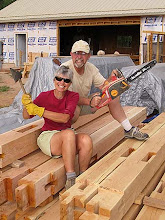
Dave at the saw
Tyse on porch decking
As we pulled away, Dave and Tyse were finishing the last of the decking on the porch roof. There was nothing more Scott and I could do for the moment and Logan obligations called from the north.

Reviewing the progress of this second building season, we have...

* put a wood-burning stove in the yurt
* planted and fenced 20 trees - 10 cottonwoods, 1 Fat Albert blue spruce, 5 blue spruce seedlings, 2 apple trees, 1 plum tree, 1 cherry tree
* installed the PEX for the entire floor
* poured the concrete floor in the bedroom, office, kitchen and master bathroom
* laid the first five inches of the earthen floor (the last one inch to be installed later)
* insulated the foundation with Pink Panther rigid foam
* mortared slate to the entire exterior of the foundation
* built a sill plate for the straw bale walls
* buried the 21,000 pound water storage tank for the solar water heating system
* graded the building site to eliminate piles of dirt and fill in holes
* finished and raised all of the timber frame (HOORAY!!!)
* assembled the core of the Tempcast masonry heater
* purchased and stacked 500 bales of straw in the garage and to the north of the garage
* cut, sanded and sealed all of the porch posts, rafters and beams
* erected the porch
* framed the interior walls
* selected and purchased almost all of the lights for the interior and exterior of the house (This had to be done in order for the electrician to wire the house.)

Solar Mechanical "Room"
Trent Hunt has placed all of the electrical wires above the ceiling. Phillip Winters has completed as much of the solar heating and water system as is possible without a finished roof. Tyler Torgerson and crews have completed the decking for the entire ceiling and porch plus added the waterproof felt layer and the metal drip edge.

While we work here in Logan, Tyler and crew will continue working. Eventually the phone will ring, and we’ll head back to Torrey to blow the insulation into the roof.

For now, Scott and I have called a hiatus. We know the first, middle, last and nick names of every piece of wood in our entire house. Our sweat, tears and not just a little blood linger everywhere. There is still so much to be done. Maybe we can complete our 2010 "to-do list" before the 2011 season begins.
November 2010


November 2009

Wednesday, November 10, 2010

So Much For Plans

6:45 AM; Wednesday morning; November 10; Torrey, Utah; Mary and Scott’s yurt...19 degrees F inside, 21 degrees F outside. It’s hard to drag yourself out of bed when your breath is visible in the air and the water in the teapot is frozen.

We force ourselves out of toasty sleeping bags and stoke the wood stove just enough to boil tea water and thaw our fingers so we can eat breakfast. The decking for the porch, waiting in tall stacks around the house, must go up. Last night the weather service predicted a 50% chance of snow – this morning the revised forecast is 70% chance of snow.

The roofing crew of two, Dave and Tyce, show up at 9:00. Scott and I have the chop saw ready for action. The pale sun disappears behind darkening clouds descending quickly from the west. By 10:00 the snow begins to filter toward us from thickening skies, and, by 10:30, the 70% chance of snow becomes a 100% chance of snow. Work ends for the day.

So much for plans...

It begins to snow...

Tuesday, November 9, 2010

A Chance of Snow

Six wonderful days of hiking! It’s hard to believe that we would actually be seeking shade in November, but it was warm and so fabulously beautiful. Harris Wash, the creek wending its way to the Escalante River, golden cottonwoods, deep silence, enigmatic petroglyphs and quicksand. Quicksand as deep as Scott’s waist! After two days of hiking, we agreed it was too dangerous to continue and retreated to a different trail, this one along the Escalante River starting from the bridge at Calf Creek on Highway 12.

Again, luxuriously warm (for November), a meandering river and camping at Sand Creek Wash. We spent the last day out exploring Sand Creek. Brilliant cottonwood leaves reminiscent of stained glass windows, river birch juxtaposed against monumental sandstone walls patterned with desert varnish and deposition layers petrified with time, mountain lion footprints in the sand. This hike was a glorious reminder of why we love this region.

Now it’s back to work on the roof and the weather forecast is for snow across the state. Monday there was a 70% chance of snow in Torrey. All day long we sanded and sealed 2” X 8” tongue and groove. Dave and Tyse began putting the porch decking in place while Phillip and Dale worked on the solar heating system. We worked mostly in sunshine but always in wind and only briefly in snow, in late afternoon. So what, exactly, does 70% mean? Does it mean 70% of the hours will have snow? Does it mean 70% of the land area will experience snowfall? For us it meant we had the entire day to work until rain with occasional snow began at 4:00. So much for 70%.

This morning the temperature inside the yurt was 25 degrees. Outside the yurt it was 24 degrees, but we worked the entire day in sun (and, of course, wind) while the decking on the north porch was completed.

Who knows about tomorrow. The forecast  says 50% chance of snow with a high of 34 degrees. Luckily Scott and I have thermal coveralls to fend off the weather. We are determined to get this roof done. Twenty-four hours from now, we’ll know what 50% chance of snow meant.

Saturday, October 30, 2010

Roof, Rain and a Looming Deadline

Scott returned to Logan last Monday and together we are heading back to Torrey next Monday. We haven’t been on a single backpacking trip for an entire year. To remedy that sorry state, one of the very first things we’ll do when we arrive is pack up our llamas and hit the trail. We plan to head down Harris Wash for a late-season, multi-day trip ensconced in red rock heaven.

This begs the question, how is it possible we’ve found ourselves with this backcountry deficit when we love exploring that landscape so much? The answer is a combination of a roof, too much rain and a looming deadline.

One reason we’ve chosen to build with straw bales is their high r-value. R-value, or resistance value, is a measurement used to designate the insulating value of specific materials used in construction.  Higher R-values indicate a material's greater ability to insulate. Three inches of fiberglass insulation has an R-value of 11. Straw bale walls have r-values ranging from 40 - 55. This means we’ll be very toasty in winters, cool during the summers and our low utility bills will put smiles on our faces.

With walls like that, it only makes sense to have a tight roof as well. The design of our roof should provide an r-value in the neighborhood of 60. From the inside out, our roof consists of 2” x  8” tongue and groove from salvaged ponderosa pine trees, roofing felt, 16” scissor trusses filled with nearly five tons of cellulose insulation made of recycled newspapers, 5/8 inch sheathing, 1 1/2 inch foam covered with reflective radiant barrier and, finally, metal that matches the roof on the garage. I guess you could think of it as the Dagwood sandwich of the roofing world.

To make our project a little more interesting, the wiring for the entire house must come through the roof. That’s because we don’t want any penetrations in the walls since those could conduct moisture into the straw.

Let’s just say the progress of the roof construction has been hindered by busy schedules and atypical rain. Scott was in Torrey for 12 days prior to his return to Logan. It rained for nine of those days. Not much building happens when the sky is pouring on your project.

As it stands now, there is tongue and groove plus felt on about half of the roof. All of the scissor trusses are up.


Most of the wiring is in. But there is oh so much more to be done. It’s raining right now. There is snow on the peaks. Our season is coming to a close. Without a roof, we cannot get the solar panels on the house. Without solar panels, our heating system isn’t complete. To get our grant from the state of Utah, this all must be done by March.


We’ve worked hard all season. The trip with our llamas will be wonderful. Then we’ll see what can be finished before winter sets in.

Sunday, October 3, 2010

Local Timber

Scott has been working for 28 days straight, 8:00 AM until after dark almost every night, in an attempt to complete the timber frame so we can begin stacking bales of straw. I was only able to be in Torrey for five of those 28 days. Little did I realize there was still so much wood work to do.

It wasn’t until we began cutting, sanding, sealing and raising the rafters for the porch did it sink in that the porch almost doubles the footprint of our house. Yes, we want outdoor living space. Yes, we need protection for the plaster walls. And, yes, it makes it all seem big ... much, much bigger than I had imagined.

Wood for our entire house comes from forests in the Torrey area. The trusses, posts, purlins and girts are douglas fir. The rafters and posts for the porch plus the and 2” X 6" tongue and groove for the ceiling are salvaged beetle and fire-killed ponderosa pines. Once it’s sanded and sealed, that salvaged wood is fantastically beautiful. We’ve never seen anything like the yellow,  orange and chocolate browns colors that appear as we apply the beeswax seal.

Scott devised a method to cut a lovely curve in the ends of the porch rafters. This small detail created a graceful elegance to what might otherwise feel heavy and ponderous.

A local visitor told us he was happy to see local timber used in such a beautiful way. We can’t help but agree.

Wednesday, September 22, 2010

Summer Vacation

Remember that old writing assignment from school? The one entitled "What I Did for My Summer Vacation?"

Well, when our longtime friend, Nikki, and her friend, Tracey, get back to Chicago, they'll be able to answer that question with two words...sanding and sealing. Nikki drove all the way to Torrey in July and spent many long hours sanding braces and trusses plus working on a long list of odds and ends. As if that wasn't enough fun, she came back last week with Tracey, and together they spent another five days sanding and applying Skidmore's Liquid Beeswax to twenty-eight porch posts.

Sanding is a time-consuming, arm-numbing job that taxes muscles and fills lungs with saw dust. We've christened our belt sander, an experienced Rockwell, The Locomotive because of its deafening roar and its ability to knock you off your feet if you are unprepared for takeoff when you push the trigger.

How did we get so lucky as to have friends who spend their summer vacation like this?

Sunday, September 5, 2010

Some Assembly Required

Over a year ago, beginning on August 15, 2009, Scott and I had a lesson on timber framing with Adam Riley from Teton Timber Frame Company. He and Jake, one of his employees, drove to Torrey from Driggs, Idaho to teach us as much as they could cram into our brains in three long days about the business of cutting our own timbers. At the end of the crash course, we had cut the posts, girts and truss for one bent of our eight-bent house. Scott and I were exhausted, and I shed a good number of tears because it had been so much work and we had so far to go.

In September we spent another three weeks building two more trusses. It was a challenge trying to decipher what all of our notes from Adam and Jake meant, not to mention dealing with timbers that had had another month to twist and turn in the heat of the warm autumn days. Still, as that building season ended, we felt we would really be able to complete work this summer.

Always the optimist, I thought we would be finished and ready for a raising by early July. Scott, the realist in the team, thought we’d be lucky to be ready in early August. A year and ten days after our shaky beginning, all of that work came together as Adam, his employee Mike, my mom, Wayne, Doug, Shanna, Scott and I raised the frame of our house.


Scott set up his camera to take a picture every few minutes to record the whole affair. It’s plain to see that some assembly was required.